

A frugal building block for semantic search
Most agents we build at work are specialists, not oracles. A support agent that answers from a few thousand policy pages. A tool-selection agent that picks the right skill out of a few hundred. The honest need is small: semantic search over a modest, mostly-static corpus. Yet the reflex answer is large: stand up a vector database, run it as a service, wire the agent to it over the network. For a few thousand documents, that is a lot of moving parts to own, pay for, and keep alive. We wondered if there was a more boring path.
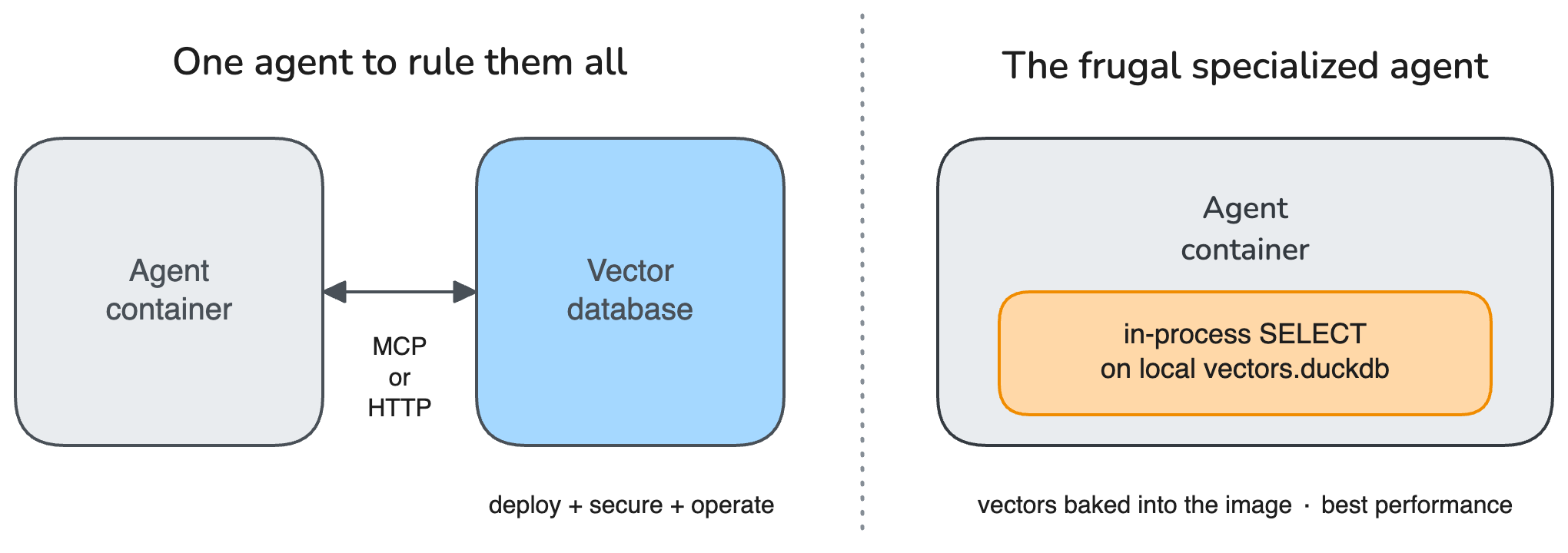
For the common case (a few thousand documents, read-mostly, packaged with one agent), you can skip the external vector database entirely. Index the corpus into a single DuckDB file, bake that file into the agent's container image, and answer semantic queries with a local function call. On a MacBook Pro M1 (2021), retrieval measured at about 27 ms (p50) over a 1,000-chunk index, fully offline and in-process, with no MCP and no network round-trip. We packaged this pattern as duckdb-vectors, a small open-source Python package.
Do you really need an external vector store?
A vector database pays off at scale: millions of vectors, high write throughput, many concurrent clients, horizontal sharding. A specialized enterprise agent usually has none of those. Its corpus fits in memory, changes rarely, and is read far more often than written. Provisioning a networked service for that workload adds latency (a round trip per query), operational surface (another thing to deploy, secure, and monitor), and cost, all to serve data that could travel with the agent itself.
The question is not "what is the most capable vector store" but "what is the least machinery that answers this agent's queries well." For the modest case, the answer can be a file.
How we internalize semantic search
duckdb-vectors treats one DuckDB file as one search index. The flow is three steps:
- chunk your documents and store their embeddings in a DuckDB database
- bake the database into the container that packages your agent
- search semantically with vector distance and exact-token matching, as usual
Indexing a folder of Markdown and PDF is a command away:
$ pip install duckdb-vectors
$ duckdb-vectors index ./docs            # build vectors.duckdb from markdown and PDF
$ duckdb-vectors search "my question"    # test hybrid search from the CLI
At the end of this step, vectors.duckdb exists in the current folder.
Semantic search is then a few lines from the agent's own code:
from duckdb_vectors import VectorStore

store = VectorStore()   # use default values

for hit in store.query("how does an embedded database work?", top_k=3):
    print(hit.score, hit.chunk.chunk_id, hit.chunk.text)
In other terms, query returns the three best chunks, each with its score. The default install is enough for a functional test. A local embedding model and the CLI work out of the box, so the first run needs no cloud account and no extra setup. Try the step-by-step RAG procedure, or browse the full documentation.
How it leans on DuckDB
The library is deliberately thin because DuckDB does the heavy lifting. Each query runs two signals and fuses them with reciprocal rank fusion: a vector distance over embedding arrays for meaning, and an exact-token match for the short literal strings that vectors handle poorly: acronyms, product codes, identifiers (BM25).
The vector signal is a brute-force exact cosine scan (array_cosine_distance over native ARRAY columns) with no approximate-nearest-neighbor index on the default path. The schema is HNSW-ready and DuckDB's VSS extension is there if someone opts in. We measured HNSW at this scale and it was not worth it: on a 1,000-chunk index it bought essentially no speed over brute force while giving up exact recall. Therefore, brute force stays the default.
The lexical index is built without stemming or stopwords on purpose, so ESRS finds ESRS while staying language-agnostic. The default embedding model is multilingual, so semantic search already covers paraphrase and synonyms across languages. Stemming would add cost and tie the index to one language without adding relevance for this use case.
That brute-force cosine scan is also where the time goes: profiling the measured ~27 ms retrieval shows it is effectively the whole budget. The default static embedding model maps tokens to fixed vectors with no transformer forward pass, so embedding the query is near-free (~0.3 ms) and the cosine scan dominates almost entirely, with BM25, fusion, and the per-hit fetch a small remainder. At a few thousand chunks that is still tens of milliseconds, and it is the reason HNSW only starts to matter well beyond this niche. In other terms, at this scale the query time is the scan time.
Chunking is dispatched by file type: a markdown community extension splits markdown into heading-scoped sections, and a PDF chunker reads PDFs a page at a time with a local OCR fallback for scanned pages. A composite chunker routes each file to the right one by MIME type, so a mixed folder indexes in one pass. Embeddings live in native ARRAY columns. Choosing one backend on purpose, rather than a lowest-common-denominator abstraction over many databases, is what lets the library stay small and lean on these DuckDB-specific features.
Baking it into the agent
The serving story is the point. The CLI builds vectors.duckdb at image-build time; at run time the container opens that file locally and can use it immediately. There is no separate data service to deploy alongside the agent and no network hop on the query path: the index ships inside the same artifact as the code, which is how modern agents are packaged anyway.
When the harness speaks Model Context Protocol rather than importing Python, duckdb-vectors mcp serves the same retrieval as an MCP server over stdio. The client spawns it as a child process in the same container and calls its search tool over stdin/stdout. Stdio is a same-container transport, not a network protocol, so the frugal story holds: no port to open, no service to secure. This is the interface that lets MCP clients like Docker Agent, Claude Desktop, Claude Code, and Cursor use the baked index with no glue code. It is also where the main integrations we have built plug in.
Point the server at a folder with --index and it builds the index on startup. The build is incremental, so an unchanged folder is near-instant. Launch it with uvx duckdb-vectors mcp --index ./docs, and an editor like Kilo Code needs neither a manual install nor a separate indexing step.
The embedding backend is selected by a string, so the same code runs offline in CI and against a cloud provider in production. The default is fastembed:minishlab/potion-multilingual-128M, a static Model2Vec model producing compact 256-dimension multilingual vectors. That choice is deliberate: the smallest vectors keep the baked database as small as possible, and the multilingual coverage means international documentation works out of the box.
It is a static embedder, so relevance is lower than a contextual model. When you want more, step up the same multilingual family by dimension: fastembed: gives a 256 → 384 → 768 → 1024 ladder (potion, MiniLM, mpnet, e5-large), with English-only bge models alongside for English corpora. For anything fastembed does not ship, the hf: loader downloads any Hugging Face ONNX model and runs real embedders like Qwen3-Embedding and Google's EmbeddingGemma (hf:onnx-community/Qwen3-Embedding-0.6B-ONNX, for instance). You are not limited to one catalog.
As a first step toward the cloud, Amazon Titan is built in for teams already on AWS. We exercised the whole thing end-to-end as a container, on Amazon Bedrock AgentCore, and as an AWS Lambda function.
In the end, DuckDB and the index file are layers of the same container image as the agent harness. duckdb-vectors does one thing (retrieval) and leaves generation and orchestration to the framework.
Where it fits, and where it does not
This is a scoped contribution, not a universal store. It fits when the corpus is in the thousands of items, mostly static, and travels with a single agent, and when a local function call beating a network round trip matters more than elastic write throughput. It does not replace a managed vector database for large multi-tenant corpora, high-churn write workloads, or sustained high-concurrency serving. Naming the boundary is part of the recommendation: the smaller scope is exactly what buys the simplicity.
The mismatch is easiest to see side by side:
| Facet | Separate vector database | duckdb-vectors |
|---|---|---|
| Corpus size | millions of vectors, sharded | a few thousand items, in one file |
| Write pattern | high-churn, live updates | read-mostly, re-indexed on build |
| Deployment | a separate service to run | a file baked into the agent image |
| Query path | MCP or network round trip | local call, in-process execution |
| Concurrency | scalable back-end service | one copy per agent replica, no shared service |
| You operate | deploy, secure, monitor, pay | pip install and Dockerfile |
Pick the left column when you genuinely have that scale. For the right column (the common specialized agent), the left column is machinery you do not need yet.
What to take away
For the normal enterprise agent, semantic search does not have to mean operating a vector database. A single DuckDB file, baked into the container, covers the common case with less machinery to own. If that shape matches something you are building, then try it: duckdb-vectors is open source and one pip install away.
It is also built to be extended. Swapping the embedding model is usually just a string (a fastembed: tier or any hf: Hugging Face repo), and both the embedding backends and the chunkers still sit behind small registries, so adding a wholly new backend or chunker is a short, self-contained contribution:
from duckdb_vectors import register_chunker

register_chunker("mychunker", lambda variant: MyChunker(variant))
Pull requests that add a documented use case, an embedding backend, or a chunker are especially welcome; see CONTRIBUTING. Thank you in advance for your feedback.
Further reading
- duckdb-vectors on PyPI, the source on GitHub, and the documentation site
- DuckDB
- DuckDB Vector Similarity Search extension
- DuckDB Markdown extension
- Boring Steps: how to stay frugal through the agentic revolution?